
How Much to Test a Business Idea Before Spending
Testing a business idea can cost much less than launching one. If you test with one session, one small batch or one customer conversation, the cash you need is often the price of a few supplies and a trip, not a website, a brand and a stock of inventory. The way to find your number is to list only what that one test requires, add it up, and decide whether you're comfortable spending it.
What is a first test, exactly?
A first test is the smallest thing you can do to learn whether someone wants what you're thinking of offering. It's not a launch. Choose one of these:
- one session with one person
- one small batch of something you make
- one conversation where you describe the offer and listen
Everything you count is for that single trial. You aren't budgeting for the business you might have in a year.
The two kinds of cost to separate
Most estimates go wrong because they mix two things together.
- One-time purchases are things you can reuse: a notebook, a tool, a tripod, a set of containers. If you already own one, it drops out of your new spending.
- Costs for this one test are things you use up or pay for during the trial: materials, printing, travel, a fee, a month of software you'd cancel afterward.
Keeping them apart shows you what you'd still own if you stopped after the test, and what you'd spend again if you ran a second one.
A worked example: how much it costs to test a business idea
Say you enjoy organizing and you're thinking about helping a neighbor who runs a small business sort out her digital files. This is a made-up example with illustrative prices, not quotes or recommendations. Your first test is one session.
| Line | Quantity | Unit cost | Total |
|---|---|---|---|
| Notebook (one-time) | 1 | 3.50 | 3.50 |
| Trip to the neighbor (this test) | 1 | 4.80 | 4.80 |
| Printed one-page guides (this test) | 2 | 0.25 | 0.50 |
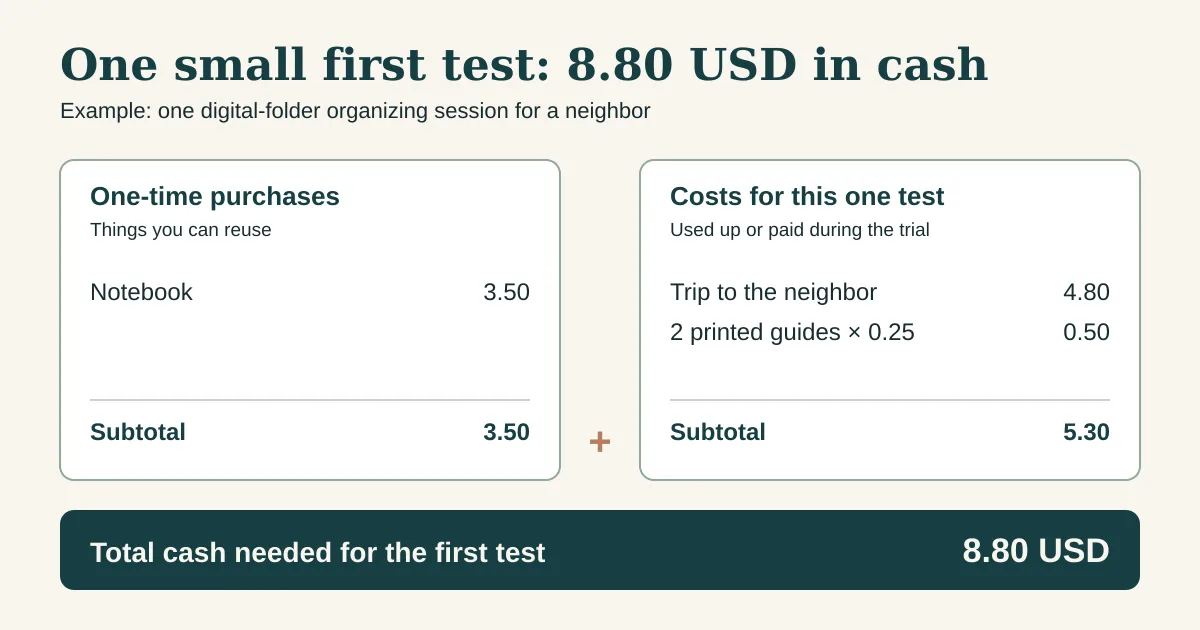
One-time purchases come to 3.50. Costs for this test come to 5.30. The total cash needed is 8.80 USD. If you already had a notebook at home, it's 5.30.
The picture below shows the same sum.
Notice what isn't in the list: no logo, no website, no business cards. None of them is needed to find out whether this neighbor has a problem you can help with.
Check your own number in five steps
- Describe the test in one sentence. "One two-hour session helping one person organize files." If the sentence has an "and" in it, you're probably describing two tests.
- List purchases you'd need to make for it. For each, ask whether you own it or can borrow it first.
- List what the test uses up. Materials, printing, travel, any fee. Don't list the same cost twice.
- Multiply quantity by unit cost, then add. Use one currency throughout.
- Write down your time and anything you couldn't price. Your hours matter, even when you aren't putting a dollar figure on them.
The free first-test cost worksheet does the multiplying and adding for you and loads this same example if you want to see it first. It needs no account, and your entries stay on the page, so copy or print your estimate before you leave.
Mistakes that make a test cost more than it should
- Buying for the business you imagine. Equipment for a hundred customers is a launch cost. For a test, one customer is enough.
- Paying for polish first. A name, a logo and a site can wait until someone has shown interest.
- Forgetting small recurring charges. A free trial that renews, a subscription you don't cancel. If a tool charges monthly, note the cancel date next to it.
- Counting sales in your estimate. A test cost is what you put in, not what you hope comes back. Plan as if nothing comes back, and treat anything that does as a bonus.
- Skipping local rules. Depending on what you sell and where you live, licenses, permits or tax registration may apply. Check with your city, county or state before you charge people, and ask a qualified professional about your own situation.
Decide before you spend
Pick a number you could lose without it hurting, and write it above the estimate. If the test costs more than that, shrink the test: fewer items, one customer, something you already own. If it still doesn't fit, that's useful information too, and it cost you nothing to learn.
Don't have an idea yet? The free idea exercise helps you turn something you can do into one question to ask first. There's a longer walk-through in how to choose a side income idea when you have none.
This article is general education, not individualized financial, legal or tax advice.