
No Business Idea Yet? How to Pick One to Try
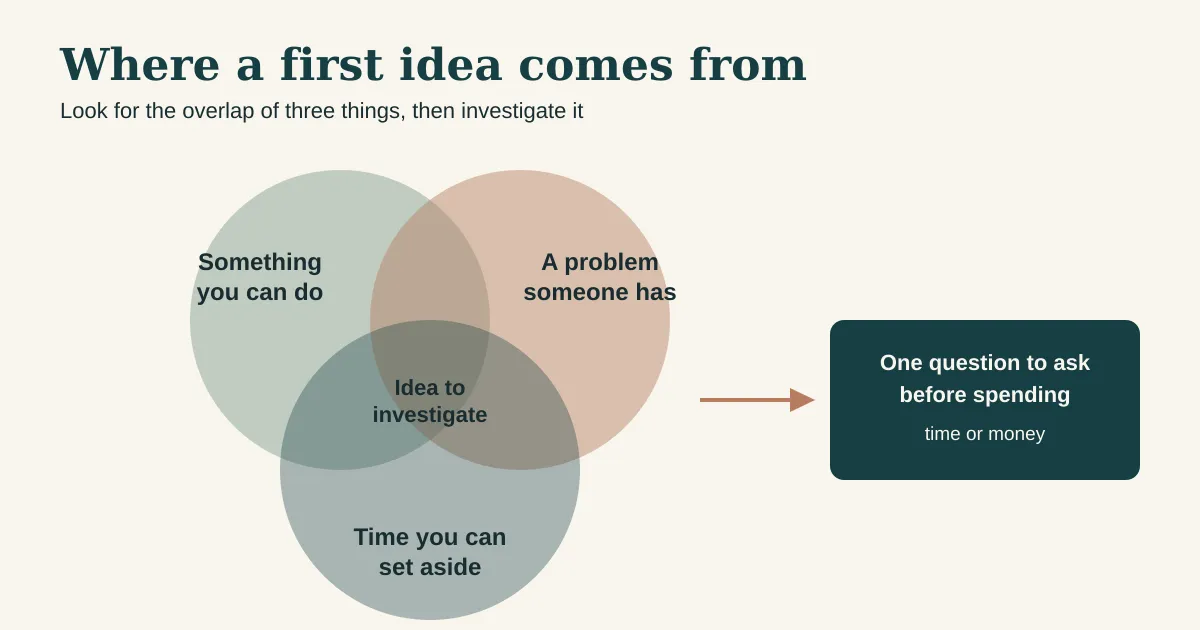
If you have no business idea yet, don't wait for a big one. Start with what you already do well, find a problem a real person has that it could help with, and check how much time you can give it each week. Where those three overlap is an idea to investigate, not a commitment to launch. Then you ask one question before spending any time or money on it.
Start from what you can already do
You have more starting points than you think, because most people discount what comes easily to them. Four everyday strengths are a useful place to look:
- Organizing things. Files, closets, schedules, paperwork, a messy shared drive.
- Explaining things. You're the friend people call to ask how a form, a phone setting or a recipe works.
- Making or repairing things. Sewing, baking, fixing, crafting, building.
- Solving everyday problems. Planning the trip, finding the better price, untangling the situation.
Pick one that fits you, not the one that sounds most impressive. If you're unsure, pick the one other people have thanked you for.
Find a problem someone actually has
A skill alone isn't an idea. An idea is a skill pointed at someone's problem. The easiest people to learn about are the ones near you: a neighbor with a small shop, a friend with a new baby, a coworker buried in spreadsheets, a relative who keeps losing documents.
Ask what's annoying, slow or put off for them. Listen for sentences like "I keep meaning to…" or "I never have time to…". Those are problems. Don't pitch yet. You're only collecting what people say.
Count the time you really have
Be honest about hours. An idea that needs ten hours a week doesn't work if you have two. The free exercise offers three sizes: one hour this week, two hours this week, or one afternoon. Small is fine. A small number of hours still gives you something real to learn from.
A worked example
Say you enjoy organizing, you own a laptop and you have two afternoons free. That's a made-up person, but the steps are real. She looks at who she knows and thinks of a local sole proprietor, someone who runs a business alone, who mentions that her digital files are a mess. The idea to investigate is helping a local sole proprietor organize digital files.
She doesn't buy software or print flyers. She asks one question: "How do you find your files today?" The answer tells her whether the problem is real, how the person describes it and whether it's worth a first session.
The diagram below shows the shape of it.
Turn the idea into one question
The question is the point. It should be something you can ask in a five-minute conversation and that doesn't cost anything. Good ones sound like:
- "How do you handle this today?"
- "What have you tried already?"
- "What's the most annoying part?"
- "If this were easier, what would you do with the time?"
If the answers are vague or the person shrugs, you've learned something cheaply. Pick the next idea from your list. If the answers are specific and a little frustrated, you've found a problem worth testing.
Mistakes that keep people stuck
- Waiting for a passion. Interest often grows after you've tried something. You only need an idea worth a small test.
- Choosing by what looks profitable online. Someone else's income story tells you little about your skills, your neighbors or your hours. No idea comes with guaranteed income.
- Picking an idea that needs a big purchase. If it needs equipment before you've talked to anyone, shrink it.
- Asking the wrong people. Friends who want to be kind will say it's great. Ask what they do today, not whether they'd like your idea.
- Treating the first idea as permanent. You can change direction after you learn more.
Your next step
Try the free idea-to-next-step exercise. Choose an everyday strength if you have no idea, pick how much time you have, and it gives you a starting point and one question to ask. It needs no account, and your entries stay on the page, so copy or print the result before you leave.
When you have an idea and a question, the next move is to find out what a first test would cost. How much it costs to test a business idea walks through that, and there's a free first-test cost worksheet to work out your own number.
This article is general education, not individualized financial, legal or tax advice.