
How Long to Test a Side Business Idea Before Deciding
How long to test a side business idea depends on how often you can run the test, not on a fixed number of months. For most part-time tests, about four weeks is enough to see whether people respond. The part that matters more is deciding, before you begin, what you'll count and what result would make you stop, keep going or change something.
Why "how long" is really "how many tries"
A test teaches you something each time you put the idea in front of a real person. If you can only do that once a week, four weeks gives you about four tries. If you can do it every day, a week might be plenty.
So start from this question: how many real tries do I need to see a pattern? Many people find that five to ten conversations or sales attempts show a pattern. That's a rule of thumb from practice, not a research finding, so treat it as a starting point and adjust it to your own situation.
Set the window on day one
Before you start, write three lines on one page:
- The question. "Will two neighbors pay for one session of help organizing their files?"
- The window. "Four weeks, starting Monday, ending on the 28th day."
- The stop rule. "If fewer than two of the ten people I ask say yes, I stop or change one thing."
Writing the stop rule when you're calm matters. Three weeks in, with money and hours already spent, every result starts to look like encouragement. The page keeps you honest without making you harsh on yourself.
A worked example: four weeks, side by side
Say you're thinking about offering to organize digital files for small business owners, around a day job. This is a made-up example with illustrative numbers.
| When | What you do | What you write down |
|---|---|---|
| Day 1 | Write the question, window and stop rule. | The three lines. |
| Week 1 | Prepare a one-page description of the session. Ask five people you know who run small businesses. | Who said yes, who said maybe, what they asked. |
| Week 2 | Run one paid or trial session. Ask five more people. | How long it took, what you'd change, whether anyone paid. |
| Week 3 | Run a second session with one change. | Same notes, plus what changed. |
| Day 28 | Read your notes against the stop rule. | Keep going, change one thing or stop. |
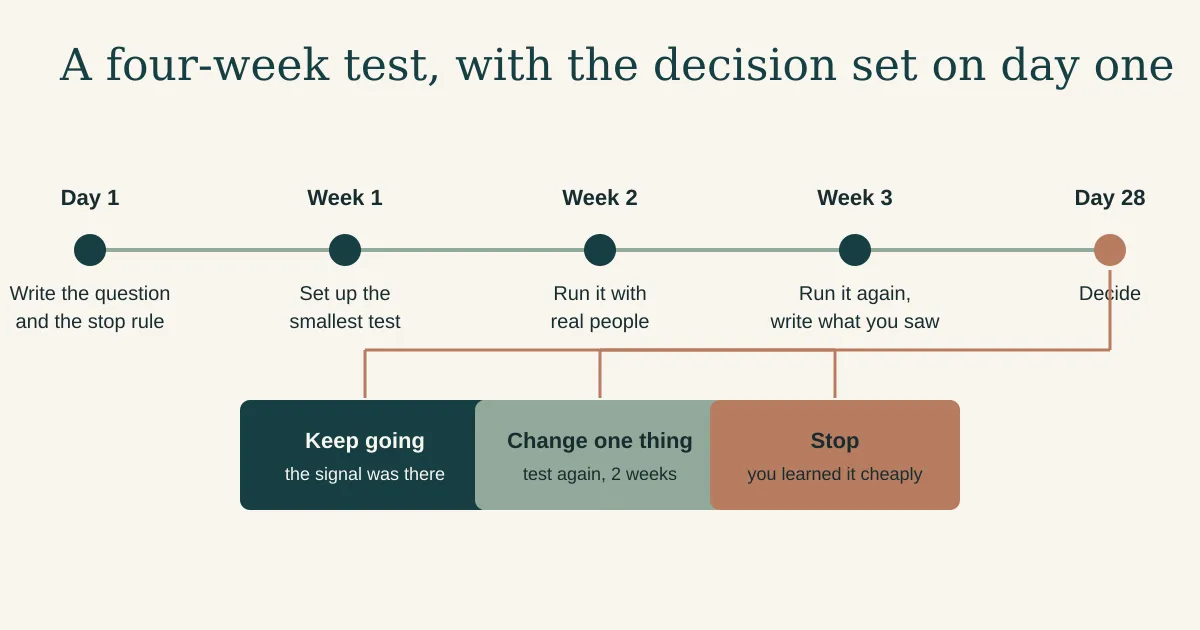
The picture below shows the same four weeks and the three ways it can end.
Say that by day 28 you asked ten people, three said yes, and two paid for a session. That's above your stop rule of two yes answers, so you'd keep going and plan the next small step. If only one said yes and the reasons were all "I don't have time right now," you might test again with a different group of people. If nobody was interested and the reasons were all about the offer itself, you stop, and the test cost you four weeks of a few hours each.
What to count, so the decision isn't a feeling
Pick two or three things you can write as numbers or short notes:
- How many people you asked.
- How many said yes, maybe or no.
- What the "no" answers had in common.
- What a session cost you in time and cash. Our first-test cost worksheet is free, takes no account, and helps you add this up before you begin.
Keep a "what surprised me" line too. Surprises are often the most useful result. If you don't have ten people to ask yet, see how to find your first customers without a following.
When to give a test more time
Four weeks isn't a rule. Adjust it when:
- You could only run it half the time. If a sick child or a busy month cost you two of the four weeks, extend by those two weeks rather than judging an unfinished test.
- The idea has a natural season. Gifts, gardening or tax-related help sell at certain times of year. Test when people want it.
- You changed the offer mid-test. Treat the change as a new test with its own window. Otherwise you can't tell which version people responded to.
When to stop sooner
You don't have to finish a window that's clearly answering "no." Stop early if the cost passes the number you set, if you've asked your full ten people and the pattern is plain, or if you realize you dislike doing the work. That last one counts as a result too. When the window ends without the result you hoped for, what to do when your business test doesn't work covers the next move.
Mistakes that stretch a test out
- No end date. "I'll see how it goes" can run for months without teaching you anything new.
- Counting only friends who say kind things. Polite praise isn't a yes. A yes is someone agreeing to a time, a price or a next step.
- Changing three things at once. Change one thing, then run again.
- Treating one result as the whole answer. A first test is a first look. A "no" from ten people tells you about this offer, in this form, to these people.
- Skipping local rules. Depending on what you offer and where you live, licenses, permits or tax registration may apply once you charge people. Check with your city, county or state, and ask a qualified professional about your own situation.
The next step
Write your three lines today, then add up what the first test would cost with the free cost worksheet. If the number feels fine, set a start date. If you don't have an idea yet, read how to pick a side business idea when you have none, and for the money side see how much it costs to test a business idea.
This article is general education, not individualized financial, legal or tax advice.