
Side Income Ideas for Women With Limited Time
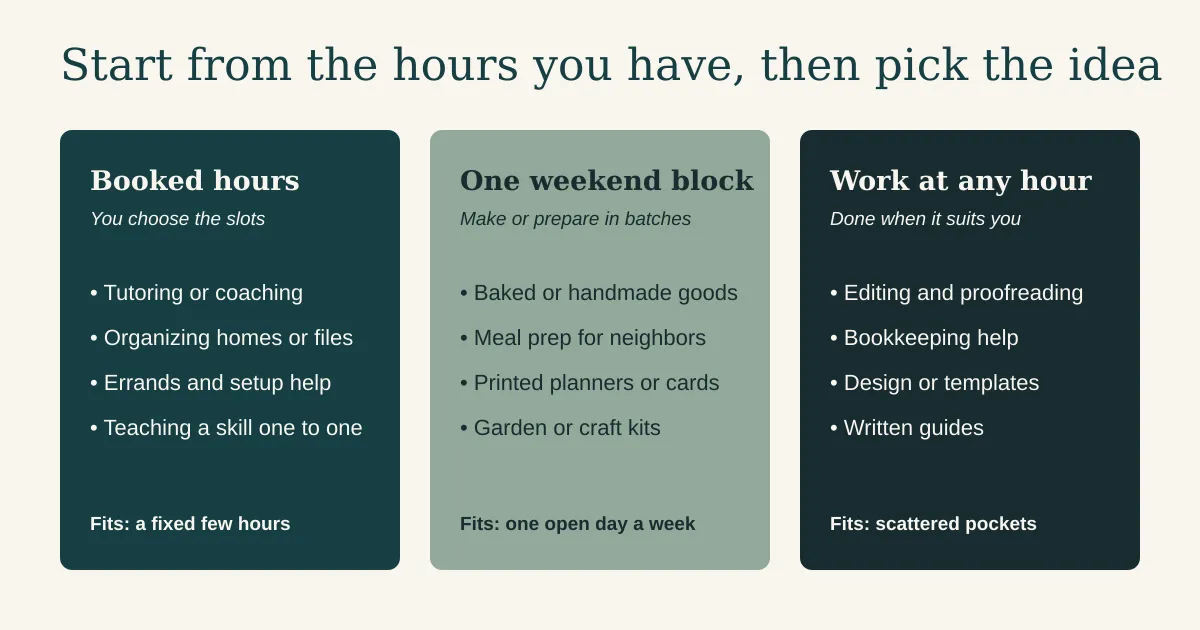
If you have limited time, the best side income idea is usually the one that fits the shape of your hours, not the one with the biggest promise. Some ideas need booked hours with a person. Some need one open block a week. Some can be done in scattered pockets of the day. Pick the group that matches your week first, then choose one idea from it and test it small.
Start with the hours you actually have
Before you look at any list, write down the time you could give in an ordinary week, not a perfect one. Count three things:
- How many hours. Two? Five? Be honest, including the weeks that go wrong.
- When they fall. Early mornings, school hours, after bedtime, one weekend day.
- Whether you can be interrupted. Some work needs an hour of quiet. Some survives being stopped and started.
Nobody is behind for having a small number. A small number simply points to a different kind of idea.
Which side income ideas fit which kind of time?
The picture below groups common ideas by the time they ask for. These are starting points for thinking, not predictions of what anyone will earn. Results vary a lot with where you live, your skills and how many people want what you offer.
| Your time looks like | Ideas that tend to fit | The trade-off |
|---|---|---|
| A fixed few hours at set times | Tutoring, teaching a skill one to one, organizing a home or files, errands and setup help | You trade hours for money directly, so growth is limited by your calendar. |
| One open block, like a Saturday | Baked or handmade goods, meal prep for neighbors, printed planners or cards, craft kits | You make in a batch, but you also need a way to sell it and sometimes a license. |
| Scattered pockets at any hour | Editing and proofreading, bookkeeping help, design or templates, written guides | You can work around your life, but you often need to build trust with strangers first. |
How to choose one idea from the list
Use three questions, in this order.
- Do I already know how to do it? An idea that needs a new skill, new equipment and new customers is three projects. Pick one that uses something you can already do.
- Can I picture the first customer by name or type? A neighbor, a coworker's friend, a parent from school. If you can't, the idea is still too vague.
- Can I try it in one session or one batch? If it takes weeks of setup before anyone can say yes or no, it's a poor first idea for a busy schedule.
If two ideas tie, pick the one you'd be less annoyed to do on a tired Tuesday.
A worked example: three hours a week
Say a woman works full time and has about three hours a week, mostly Saturday mornings. This is a made-up example. She's good at spreadsheets and likes tidying other people's messes. Looking at the groups, "organizing files" sits in the booked-hours column, and "bookkeeping help" in the any-hour column. She asks the three questions. She already knows both skills. She can picture a first customer, a friend who runs a small bakery. Only the file organizing can be tried in a single session.
So her first test is one two-hour Saturday session helping the friend sort her digital files. It needs no new skill and no website. She writes down what the session cost her, what the friend said afterward, and whether the friend would pay for another one. That's enough to learn something real in about two hours.
What to watch for when time is short
- Ideas that need constant replies. If customers expect an answer within minutes, a packed week makes that stressful.
- Pricing yourself by the hour without counting prep. The hour you spend with someone often needs another hour of preparation and follow-up. Count both.
- Starting five things. One idea, one test. Pick another only after you've learned something from the first.
- Stacking guilt on top of a full week. You're allowed to run a small, slow test. A quiet start is still a start.
- Skipping local rules. Depending on what you offer and where you live, licenses, permits, food rules or tax registration may apply once you charge people. Check with your city, county or state, and ask a qualified professional about your own situation.
Your next step
Write your realistic hours on a page, circle the column that matches them, and choose one idea you could try in a single session. The free idea exercise helps you turn something you can already do into one question to ask a first customer. It needs no account.
Once you have a question, two other articles help with the rest. How much it costs to test a business idea shows how to add up a first test, and how long to test a side business idea helps you decide when to stop, change or keep going. If you're still stuck on the idea itself, read how to pick a business idea when you have none.
This article is general education, not individualized financial, legal or tax advice.